The Stars of Pallas Ridge: A Vintarinian Memoir
The party was a magnificent affair. From the welcoming word of Mahalo to the spirited cry of “Agbiag ti Vintar,” it was a night to remember. We all converged at the Ala Moana Hotel for the final grand event of the celebration: the 2017 Vintarinian International Reunion, hosted by Vintar O'hana International of Hawaii.
I brought two camisa de chino shirts with me. Both were white cotton with three buttons down the chest—one short-sleeved and one long-sleeved. The last time I wore a traditional barong to a wedding, I wore a short-sleeved undershirt. It felt too tight and made me sweat. This time, I made sure both shirts were loose, yet snug enough. As a grown-up, I had always worn long-sleeved camisa de chino shirts, but only to bed as pajama tops. I liked them that way, never tucked underneath a barong.
Tonight, however, I tried something new. I wore the long-sleeve version under my barong and left it untucked. I was surprised by how it made the sheer barong look like a tailored coat. I looked in the mirror. I could not help but think of the Filipino revolutionaries under Andrés Bonifacio, portrayed wearing the camisa de chino open at the neck and untucked. If only I had held a bolo knife in my hands, the image of an archetypical Filipino—a true Vintarinian—would have been complete. I laughed quietly at my own reflection.
The party was already in full swing when I arrived. Rufee and Elsa, a married couple I have known for a long time, greeted me at the door. “You look like a waiter,” Rufee joked. “Look who is talking,” I parried. “A magsasaka—that is how you look in that colored barong!”
Elsa looked splendid. She wore a striking red gown with embroidered flowers on the front and on both traditional butterfly sleeves, finished with a matching pearl necklace. The dress code was strict and serious: a barong for the men and a Maria Clara gown for the women. Of all the events packed into the past three days, this grand evening truly embodied the heart and soul of our heritage.
Seeking a brief escape from the crowd, I decided to take a drive and walk through Kapiolani Park, located just across from the famed Waikiki Aquarium. It was dark when I carefully parked my jeep along Kalakaua Avenue and stepped out into the night. Immediately, the cool island breeze washed over my face, bringing an immediate sense of calm and peace. It turned out I wasn’t entirely alone. A few night walkers paced the loops, others quietly watched the reflection of a nearby pond, and some stood completely still, gazing up at the stars.
As I fell into a steady walking stride, my eyes drifted upward. Suddenly, the Honolulu skyline faded, and I was instantly transported back to a specific childhood night in Vintar, when Tatang took all six of us children stargazing. Earlier that day, Tatang had given us strict instructions: do not go to bed early tonight. He told us he wanted to give each of us a special gift—something we would carry with us for the rest of our lives.
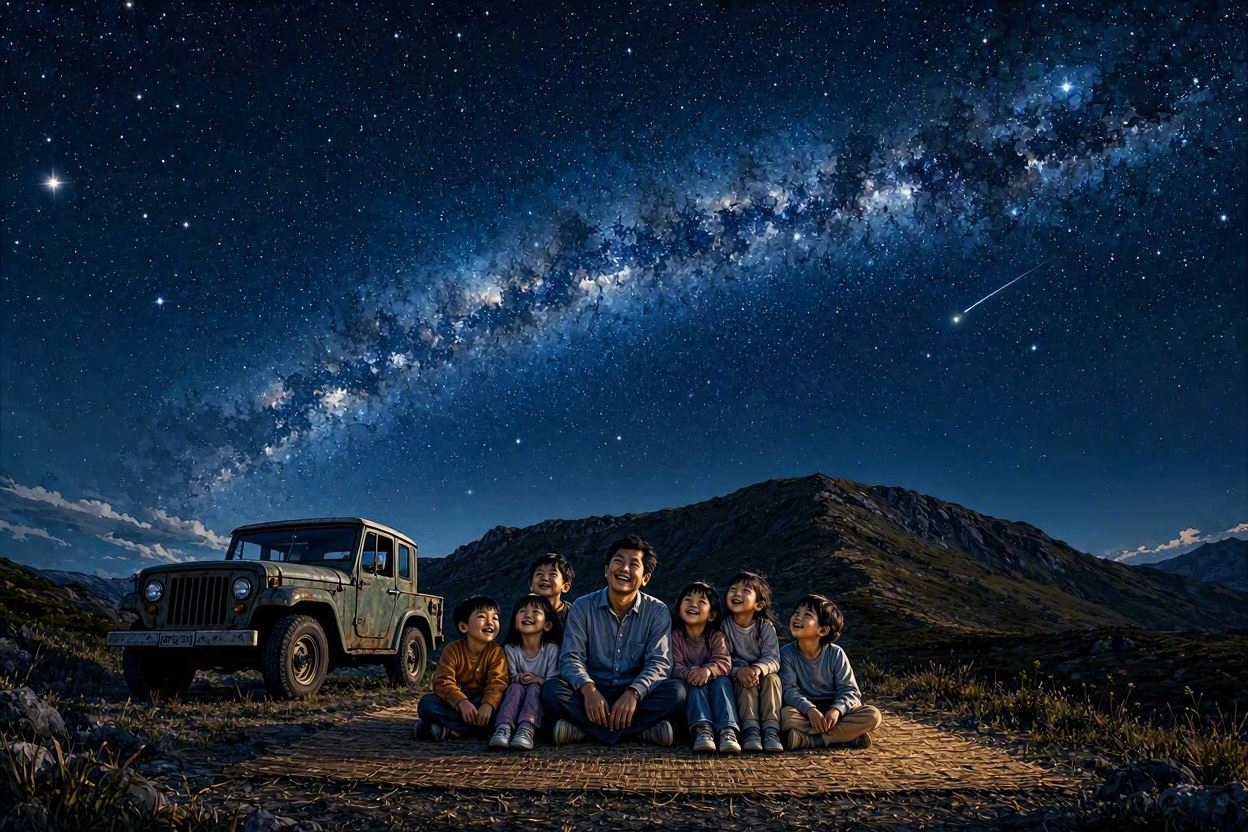
It was a December night, just before Christmas Eve, when he packed us into the jeep and drove up to the top of Pallas Ridge. It was pitch black; we could barely see each other's faces inside the vehicle. The ride was bumpy as the jeep navigated the unpaved, gravel road winding up the face of the mountain, but Tatang kept it steady. When we reached a bend at the highest point of the road, we stopped. We scrambled out of the jeep and followed him down a narrow trail that led to a cleared knoll. The absolute darkness spooked us a little bit. Sensing our unease, Tatang unrolled a straw mat on the grassy ground and told us to sit.
"What are we doing up here in the middle of the night?" we questioned him, shifting restlessly.
A warm breeze was drifting up from the Pallas Valley below. At night, the mountain land doesn’t cool down right away; the trapped daytime heat creeps up the slopes and briefly engulfs the knoll. But it never lingers long. Soon, a crisp breeze from the waters of the Bislak River would take over, cooling the ridge as the mountain went to sleep. To keep us occupied, Tatang handed us toasted pakkak seeds to munch on.
"Is this our gift?" we asked in chorus, holding up the seeds.
"No, silly," Tatang chuckled. "Look up."
We looked up into the moonless night and gasped. Spreading across the sky was an extraordinary, breathtaking sight: millions of twinkling stars, shimmering like diamonds scattered across silken black velvet. It was stunning. The sky felt impossibly vast. We actually stood up and reached out our hands, trying to touch them. The stars felt so close, appearing as large and wide as our own amazed eyes. Suddenly, a shooting star streaked across the dark canopy.
"Unbelievable!"
"Awesome!"
Tatang began pointing toward the glowing clusters, calling out their names loudly into the night: "Orion! Taurus! Sirius! Gemini! The Big Dipper!" He swept his hand across the horizon. "That is the whole Universe," Tatang said. "Vintar is the center of the Universe. And right now, you are standing in the middle of Vintar."
"We are masters of the Universe!" we shouted into the open air.
"Yes, you are made of stardust," Tatang agreed, his voice filled with pride. "You are children of the Universe, rulers of the skies."
"We rule!" we cheered.
Then, Tatang quieted us down. "Now, for your gift. It is a gift that will stay with you forever."
"Even when we die?" one of us asked.
Tatang responded with absolute authority. "Absolutely. Up there is Heaven. Tonight, I am naming a star for each of you." He raised his finger, pointing directly to a bright, pulsing light. "You see that twinkling star? That is Jem’s star."
"Where is my star?" I asked eagerly.
Tatang adjusted his aim, pointing to a brilliant beacon hanging directly overhead. "That one right there, Dodong—that is your star." He went on around the mat, pointing and assigning a unique star until he had completed the circle, naming six distinct stars for his six children. "Remember," Tatang told us all those years ago on the ridge, "when you leave this earth, your star will be waiting for you in Heaven."
Feeling a bit tired from my walk through Kapiolani Park, I sat down on a bench, thinking of how chatty and full of wonder we had been as kids. I looked up at the Hawaiian skies. Sadly, the unshielded, neon glow of Waikiki blurred the stars. Light pollution is everywhere now. Modern life has stolen one of the most fundamental human experiences: the ability to walk out your front door and come face-to-face with the universe. Throughout the ages, the night sky has inspired art, poetry, philosophy, and science. I felt deeply grateful that we, as children, had the opportunity to witness the true grandeur of the Milky Way. There should be a conscious effort to protect the dark skies of Vintar. The city lights made me remember how disappointed my own son had been during a trip to Los Angeles.
"But Dad, why don’t we see any stars here in LA?" he had asked.
"You only see stars in the dark, son," I explained gently. "Without darkness, we would never see the stars."
I surprised myself by saying that. It brought back a forgotten, simple, yet powerful line I had once read in the Bannawag magazine: “Kada agsipnget,” kari dagiti bituen, “inkam’ gumilap.” ("Every time it gets dark," promise the stars, "we will shine.")
In that same vein, my Nanang used to quote a beautiful counter-phrase: “Kada agsapa,” insapata ti Init, “innak bumangon.” ("Every morning," swears the Sun, "I will rise.")
As a young boy, I never fully understood what those words meant. When I asked Nanang, she simply smiled and said endearingly, "You are too young to understand it now. But always remember this word: Namnama."
As I grew up, whenever a day didn't go my way, I anchored myself to those words. Another day was always coming. That is Namnama. It is the unique ability to see the light when you are surrounded by darkness. It is convincing yourself that there is always a light at the end of the tunnel. It is the realization that in your darkest hours, your true friends reveal themselves—shining like the stars in your life. This was the lesson I passed down to my son about the heavens. It was also exactly what I witnessed in the faces of the people at the reunion. They were people who had seen the light at the end of the tunnel, venturing far and wide away from Vintar to reach for a better life. Namnama is the very ethos of a Vintarinian.
The cool night breeze washed over me, calming my thoughts. It had been a fabulous day, the kind you wish you could freeze in time forever. But reality called; I had a flight back to Los Angeles tomorrow and needed to rest. I stood up from the park bench and began walking back toward my jeep.
The reunion had reawakened a warm, long-forgotten feeling within me: the feeling of being truly at home. I had been away from Vintar for more than forty years, and I had forgotten what that felt like. People often throw around the old cliché that "home is where the heart is." But for the Vintarinians gathered in that ballroom, that wasn't exactly true. Their hearts didn't shift to wherever they moved. Vintar would always be the place for which they held the deepest affection, no matter where they landed in this vast global diaspora. Their hearts still live in Vintar. And now, after all these years, I realized my heart does too. Before opening the jeep door, I took one last gaze upward into the faded, starlit skies of Waikiki, looking past the city glare to see the brilliant, eternal stars of Vintar on top of Pallas Ridge.
Namnama.
The party was a magnificent affair. From the welcoming word of Mahalo to the spirited cry of “Agbiag ti Vintar,” it was a night to remember. We all converged at the Ala Moana Hotel for the final grand event of the celebration: the 2017 Vintarinian International Reunion, hosted by Vintar O'hana International of Hawaii.
I brought two camisa de chino shirts with me. Both were white cotton with three buttons down the chest—one short-sleeved and one long-sleeved. The last time I wore a traditional barong to a wedding, I wore a short-sleeved undershirt. It felt too tight and made me sweat. This time, I made sure both shirts were loose, yet snug enough. As a grown-up, I had always worn long-sleeved camisa de chino shirts, but only to bed as pajama tops. I liked them that way, never tucked underneath a barong.
Tonight, however, I tried something new. I wore the long-sleeve version under my barong and left it untucked. I was surprised by how it made the sheer barong look like a tailored coat. I looked in the mirror. I could not help but think of the Filipino revolutionaries under Andrés Bonifacio, portrayed wearing the camisa de chino open at the neck and untucked. If only I had held a bolo knife in my hands, the image of an archetypical Filipino—a true Vintarinian—would have been complete. I laughed quietly at my own reflection.
The party was already in full swing when I arrived. Rufee and Elsa, a married couple I have known for a long time, greeted me at the door. “You look like a waiter,” Rufee joked. “Look who is talking,” I parried. “A magsasaka—that is how you look in that colored barong!”
Elsa looked splendid. She wore a striking red gown with embroidered flowers on the front and on both traditional butterfly sleeves, finished with a matching pearl necklace. The dress code was strict and serious: a barong for the men and a Maria Clara gown for the women. Of all the events packed into the past three days, this grand evening truly embodied the heart and soul of our heritage.
Seeking a brief escape from the crowd, I decided to take a drive and walk through Kapiolani Park, located just across from the famed Waikiki Aquarium. It was dark when I carefully parked my jeep along Kalakaua Avenue and stepped out into the night. Immediately, the cool island breeze washed over my face, bringing an immediate sense of calm and peace. It turned out I wasn’t entirely alone. A few night walkers paced the loops, others quietly watched the reflection of a nearby pond, and some stood completely still, gazing up at the stars.
As I fell into a steady walking stride, my eyes drifted upward. Suddenly, the Honolulu skyline faded, and I was instantly transported back to a specific childhood night in Vintar, when Tatang took all six of us children stargazing. Earlier that day, Tatang had given us strict instructions: do not go to bed early tonight. He told us he wanted to give each of us a special gift—something we would carry with us for the rest of our lives.
It was a December night, just before Christmas Eve, when he packed us into the jeep and drove up to the top of Pallas Ridge. It was pitch black; we could barely see each other's faces inside the vehicle. The ride was bumpy as the jeep navigated the unpaved, gravel road winding up the face of the mountain, but Tatang kept it steady. When we reached a bend at the highest point of the road, we stopped. We scrambled out of the jeep and followed him down a narrow trail that led to a cleared knoll. The absolute darkness spooked us a little bit. Sensing our unease, Tatang unrolled a straw mat on the grassy ground and told us to sit.
"What are we doing up here in the middle of the night?" we questioned him, shifting restlessly.
A warm breeze was drifting up from the Pallas Valley below. At night, the mountain land doesn’t cool down right away; the trapped daytime heat creeps up the slopes and briefly engulfs the knoll. But it never lingers long. Soon, a crisp breeze from the waters of the Bislak River would take over, cooling the ridge as the mountain went to sleep. To keep us occupied, Tatang handed us toasted pakkak seeds to munch on.
"Is this our gift?" we asked in chorus, holding up the seeds.
"No, silly," Tatang chuckled. "Look up."
We looked up into the moonless night and gasped. Spreading across the sky was an extraordinary, breathtaking sight: millions of twinkling stars, shimmering like diamonds scattered across silken black velvet. It was stunning. The sky felt impossibly vast. We actually stood up and reached out our hands, trying to touch them. The stars felt so close, appearing as large and wide as our own amazed eyes. Suddenly, a shooting star streaked across the dark canopy.
"Unbelievable!"
"Awesome!"
Tatang began pointing toward the glowing clusters, calling out their names loudly into the night: "Orion! Taurus! Sirius! Gemini! The Big Dipper!" He swept his hand across the horizon. "That is the whole Universe," Tatang said. "Vintar is the center of the Universe. And right now, you are standing in the middle of Vintar."
"We are masters of the Universe!" we shouted into the open air.
"Yes, you are made of stardust," Tatang agreed, his voice filled with pride. "You are children of the Universe, rulers of the skies."
"We rule!" we cheered.
Then, Tatang quieted us down. "Now, for your gift. It is a gift that will stay with you forever."
"Even when we die?" one of us asked.
Tatang responded with absolute authority. "Absolutely. Up there is Heaven. Tonight, I am naming a star for each of you." He raised his finger, pointing directly to a bright, pulsing light. "You see that twinkling star? That is Jem’s star."
"Where is my star?" I asked eagerly.
Tatang adjusted his aim, pointing to a brilliant beacon hanging directly overhead. "That one right there, Dodong—that is your star." He went on around the mat, pointing and assigning a unique star until he had completed the circle, naming six distinct stars for his six children. "Remember," Tatang told us all those years ago on the ridge, "when you leave this earth, your star will be waiting for you in Heaven."
Feeling a bit tired from my walk through Kapiolani Park, I sat down on a bench, thinking of how chatty and full of wonder we had been as kids. I looked up at the Hawaiian skies. Sadly, the unshielded, neon glow of Waikiki blurred the stars. Light pollution is everywhere now. Modern life has stolen one of the most fundamental human experiences: the ability to walk out your front door and come face-to-face with the universe. Throughout the ages, the night sky has inspired art, poetry, philosophy, and science. I felt deeply grateful that we, as children, had the opportunity to witness the true grandeur of the Milky Way. There should be a conscious effort to protect the dark skies of Vintar. The city lights made me remember how disappointed my own son had been during a trip to Los Angeles.
"But Dad, why don’t we see any stars here in LA?" he had asked.
"You only see stars in the dark, son," I explained gently. "Without darkness, we would never see the stars."
I surprised myself by saying that. It brought back a forgotten, simple, yet powerful line I had once read in the Bannawag magazine: “Kada agsipnget,” kari dagiti bituen, “inkam’ gumilap.” ("Every time it gets dark," promise the stars, "we will shine.")
In that same vein, my Nanang used to quote a beautiful counter-phrase: “Kada agsapa,” insapata ti Init, “innak bumangon.” ("Every morning," swears the Sun, "I will rise.")
As a young boy, I never fully understood what those words meant. When I asked Nanang, she simply smiled and said endearingly, "You are too young to understand it now. But always remember this word: Namnama."
As I grew up, whenever a day didn't go my way, I anchored myself to those words. Another day was always coming. That is Namnama. It is the unique ability to see the light when you are surrounded by darkness. It is convincing yourself that there is always a light at the end of the tunnel. It is the realization that in your darkest hours, your true friends reveal themselves—shining like the stars in your life. This was the lesson I passed down to my son about the heavens. It was also exactly what I witnessed in the faces of the people at the reunion. They were people who had seen the light at the end of the tunnel, venturing far and wide away from Vintar to reach for a better life. Namnama is the very ethos of a Vintarinian.
The cool night breeze washed over me, calming my thoughts. It had been a fabulous day, the kind you wish you could freeze in time forever. But reality called; I had a flight back to Los Angeles tomorrow and needed to rest. I stood up from the park bench and began walking back toward my jeep.
The reunion had reawakened a warm, long-forgotten feeling within me: the feeling of being truly at home. I had been away from Vintar for more than forty years, and I had forgotten what that felt like. People often throw around the old cliché that "home is where the heart is." But for the Vintarinians gathered in that ballroom, that wasn't exactly true. Their hearts didn't shift to wherever they moved. Vintar would always be the place for which they held the deepest affection, no matter where they landed in this vast global diaspora. Their hearts still live in Vintar. And now, after all these years, I realized my heart does too. Before opening the jeep door, I took one last gaze upward into the faded, starlit skies of Waikiki, looking past the city glare to see the brilliant, eternal stars of Vintar on top of Pallas Ridge.
Namnama.
Community-submitted memory.